
Introduction
HaloCAD for TCAI is a lightweight application that uses Microsoft Purview Information Protection functionality to decrypt HaloCAD-protected CAD files during bulk loading operations in Teamcenter integration with Autodesk Inventor. This enables protected Inventor files to be scanned and processed by the TCAI Bulk Loader.
The Teamcenter Integration for Autodesk Inventor (TCAI) Bulk Loader utility allows administrators to automatically import large numbers of Inventor files into Teamcenter. However, when Inventor files are protected (encrypted), the Bulk Loader cannot recognize or process them directly.
By decrypting protected files during the loading process, HaloCAD for TCAI enables the Bulk Loader to scan and load these files into Teamcenter.
About this Manual
This manual walks you through the process of installing, configuring, and operating HaloCAD for TCAI.
Reference
All technical manuals are included with the product package you have purchased.
Administrators should first read the Technical Reference Manual to understand the add-on's architecture and learn about the prerequisites. They should also refer to the Release Notes to learn about the supported CAD applications before following the instructions in this document.
Installing HaloCAD for TCAI
This chapter describes how to install and configure HaloCAD for TCAI.
Prerequisites
The following sections are described in detail in the Technical Reference Manual.
-
Register an Application in Microsoft Entra ID - Public client/native
-
Office 365 Subscription Details
-
Recommended URLs, Addresses, and Ports for MPIP
-
Enable Support for TLS 1.2 at the Client Workstation for Microsoft Entra ID
-
Secure Installation (Recommended)
To ensure a secure installation, create an encrypted JSON file using the admin tool and share it without exposing tenant details. Place the encrypted file with the HaloCAD installer. The installer reads configuration data from the
hc.conf.encfile and bypasses the "Initialization" screen, which would otherwise require Microsoft Entra ID application details. Note: A license key is not required for HaloCAD for TCAI.
Install the Add-on
You can install the add-on in the following modes:
-
Graphical Mode
Graphical mode installation is an interactive, graphical user interface-based method that is driven by a wizard. -
Silent Mode
Silent-mode installation is a non-interactive method of installing the add-on using command lines. -
Via System Center Configuration Manager
With System Center Configuration Manager (SCCM), the add-on is deployed on the targeted computers across your enterprise.
Graphical Mode
Before you begin
The following prerequisites must be met:
-
A user who installs HaloCAD for TCAI must have administrator rights.
-
Ensure that your Microsoft Entra tenant details are ready when the installation UI requests them. As an alternative, you can use
hc.conf.encfor a secure and automated installation.
Installation Procedure
Install the HaloCAD for TCAI using the GUI-based setup program provided in the installation package.
-
Double-click the installer
HaloCAD_TCAI_Shield_Setup.exefile. -
Depending on your Windows security settings, a prompt may appear stating, "Do you want to allow the following program to make changes to this computer?" If this warning appears, click Yes to continue with the installation.
-
When the installer starts, the Startup dialog appears, followed by the Welcome dialog.

Startup dialog
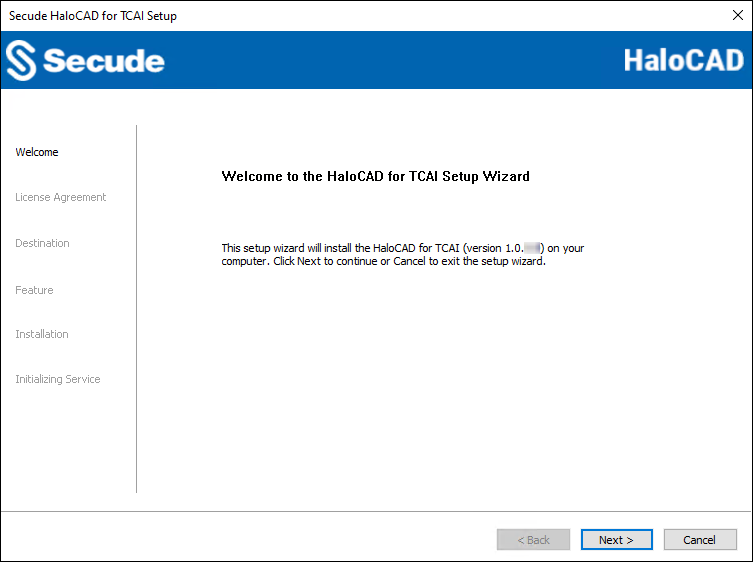
Welcome dialog
-
Click Next to continue the installation.
-
The End-User License Agreement (EULA) dialog appears.
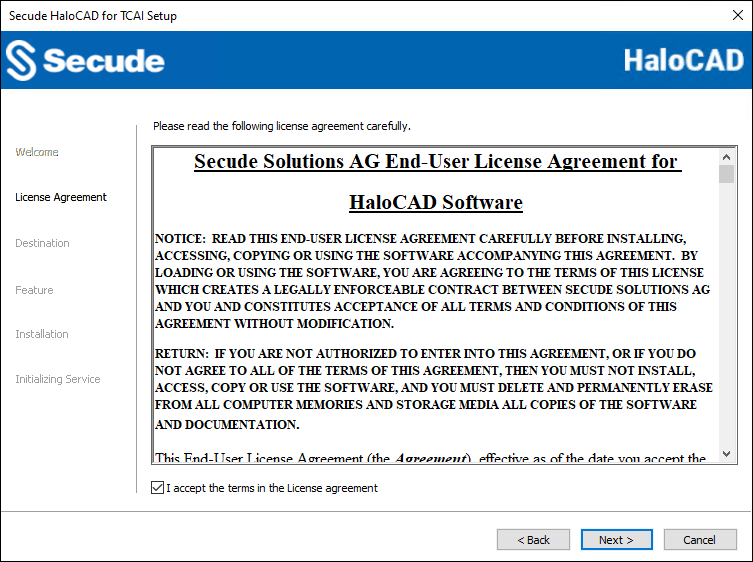
End-User License Agreement dialog
-
Read the End-User License Agreement. If you agree, select I accept the terms in the License Agreement, and click Next to continue.
-
The destination folder selection dialog appears:
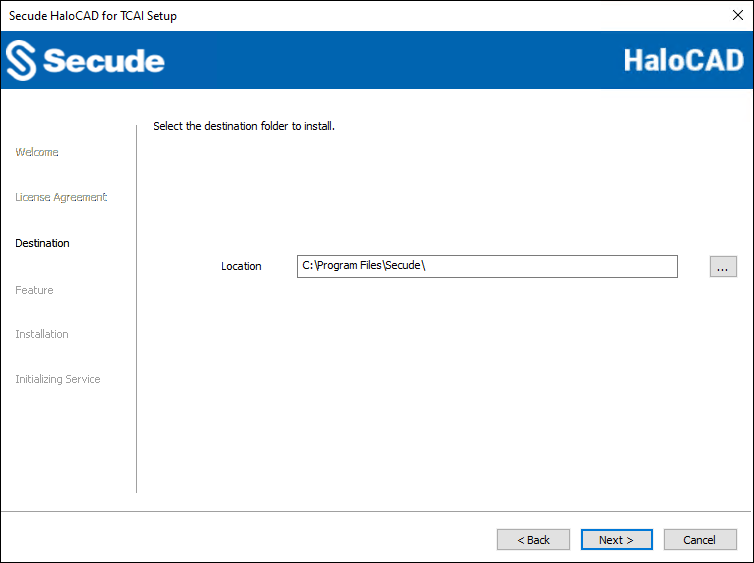
Destination folder selection dialog
-
By default, application files are stored in the program files directory (
C:\Program Files\Secude\). If you would like to choose an alternate location, click the Browse button and select your location preference. When you are finished, click Next. -
The feature selection dialog appears.
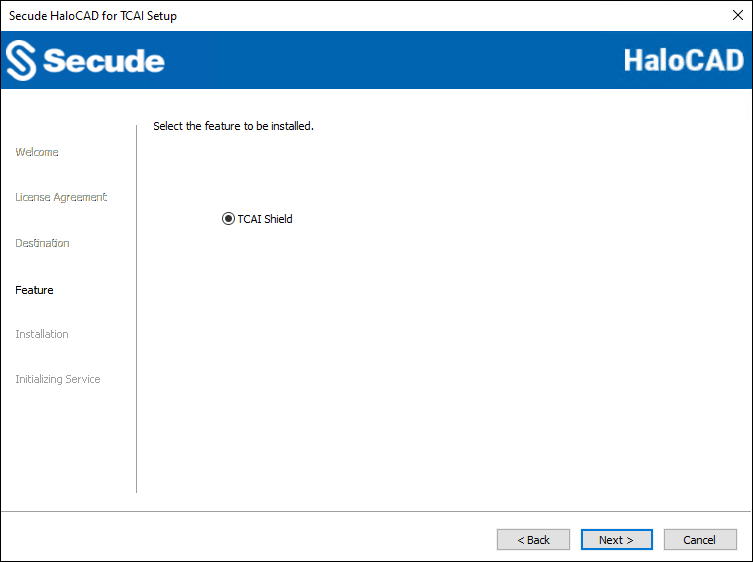
Feature selection dialog
-
The TCAI Shield option is selected by default.
-
To review or modify any installation settings, click Back to return to the previous screens. If you are ready to proceed, click Next to begin installing the application.
-
The installation begins, and the progress is displayed in the dialog.
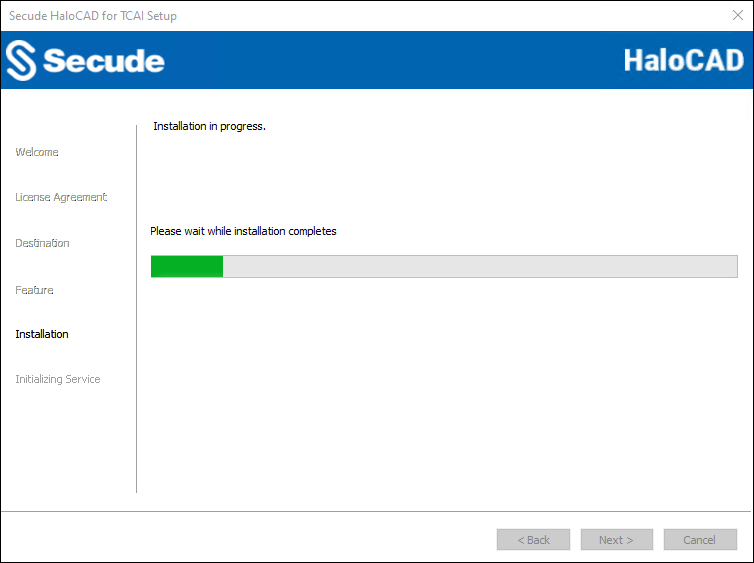
Installation progress dialog
-
When the installation is complete, a message appears confirming that the add-on has been successfully installed. Click Next to proceed.
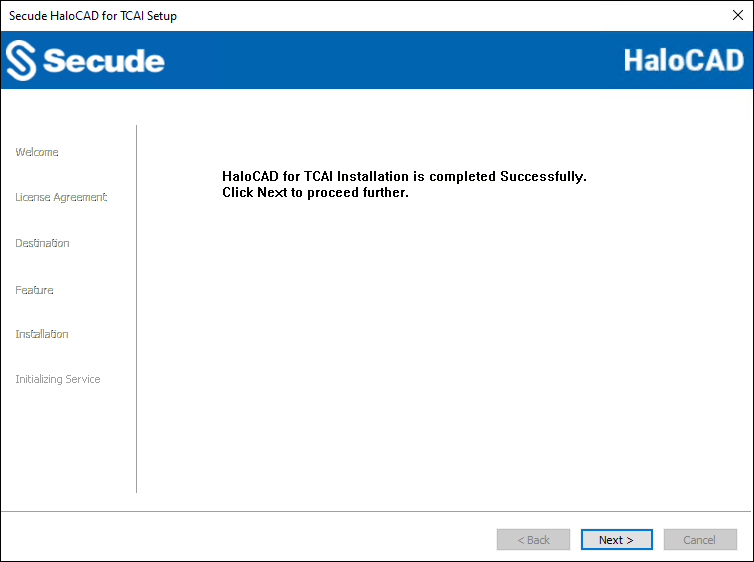
Installation completed dialog
-
The initialization dialog appears. To prevent connectivity issues, ensure that the correct Microsoft Entra ID application details are entered on the screen. Note: If the
hc.conf.encfile is included with the installer, this initialization screen is skipped and only the completion dialog is shown. The initialization screen appears only when thehc.conf.encfile is not present in the installer folder.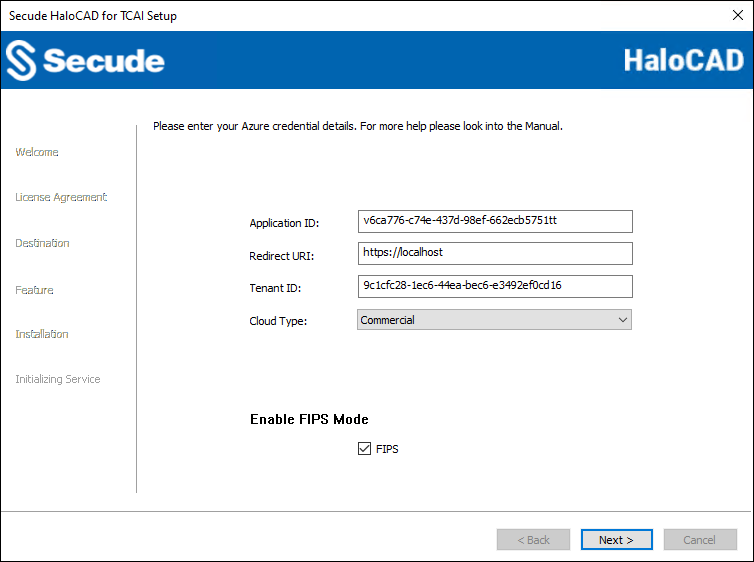
Initialization dialog
-
Application ID: Enter the unique identifier of your registered application. For example,
v6ca776-c74e-437d-98ef-662ecb5751tt -
Redirect URI: Enter the URI that was provided when registering the native application in the Azure portal. For example,
https://localhost -
Tenant ID: If the registered application is Single tenant, you need to enter the globally unique identifier of your tenant if not, you can leave it empty. For example,
9c1cfc28-1ec6-44ea-bec6-e3492ef0cd16. -
Cloud Type: Commercial is selected by default. Based on your Azure subscription and configuration, select the required cloud type from the list: Commercial, Custom, Germany, US_DoD, US_GCC, US_GCC_High, US_Sec, US_Nat, or China_01. If you select Custom, enter the appropriate URLs in the Protection Cloud URL (for example,
https://api.aadrm.com) and Policy Cloud URL (for example,https://dataservice.protection.outlook.com) fields. -
Enable Federal Information Processing Standards (FIPS) Mode: Enable this option to use encryption algorithms that comply with FIPS standards. When enabled, MPIP uses only FIPS-compliant encryption algorithms, and when disabled, it uses standard encryption algorithms. If this option was not enabled during installation, it can later be enabled through a registry entry. For more details, please refer to the section “Registry Settings”.
-
Click Next.
-
-
Once the initialization is completed, you will get the success message as shown below.
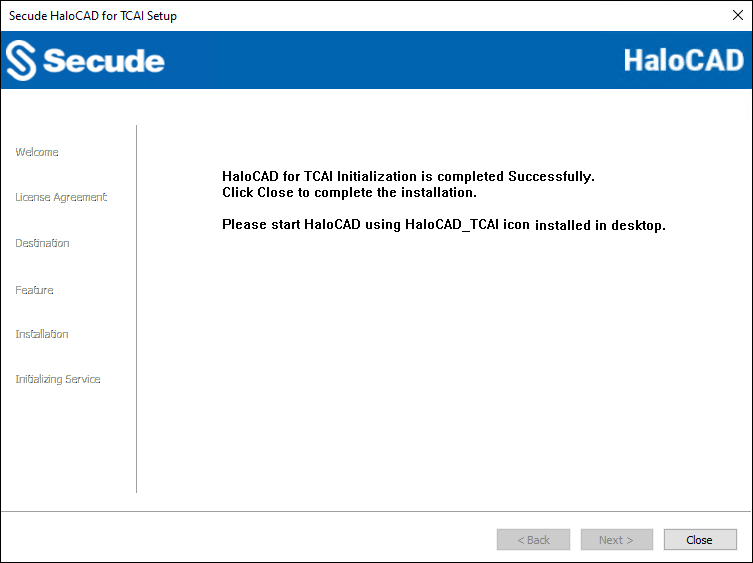
Initialization completed dialog
-
Click Close to close the installation wizard.
-
After the installation, a shortcut icon

-
To launch the application, double-click the HaloCAD_TCAI icon or navigate to All apps > HaloCAD_TCAI from the Start menu. The startup dialog appears, as shown below.
TCAI Startup dialog
Note: HaloCAD for TCAI starts automatically after a system restart or new login session. If it is already running, double-clicking the HaloCAD_TCAI icon displays the message “HaloCAD for TCAI already running.”
Silent Mode
In addition to the graphical mode, HaloCAD for TCAI can be installed in silent mode, which does not display a user interface and requires no user interaction. This provides a convenient way to streamline the installation by executing the command once.
-
Open the Command Prompt with elevated rights (Run as Administrator).
-
Navigate to the installer directory.
-
To know the list of options available in silent mode, follow the steps given below:
TypeHaloCAD_TCAI_Shield_Setup.exe -help
PressEnter
Output
...
HaloCAD_TCAI_Shield_Setup.exe [-install [-tcaishield] [-dir <destination_directory>]
[<ApplicationID> <Redirect URI> <TenantID/Name> <Cloud Type ("Commercial"|"Custom"|"Germany"|"US_DoD"|"US_GCC"|"US_GCC_High"|"US_Sec"|"US_Nat"|"China_01"|"")>
[(if Custom) <Protection Cloud Url> <Policy Cloud Url>] [-enablefipsmode <true|false>]
For Silent Mode Installation if ENC file already exists in the same location
HaloCAD_TCAI_Shield_Setup.exe [-install [-tcashield] [-dir <destination_directory>] [-enablefipsmode <true|false>]]HaloCAD_TCAI_Shield_Setup.exe [-uninstall -silent <true|false>] -
The following command illustrates how to install the add-on using the Azure application details.
HaloCAD_TCAI_Shield_Setup.exe -install -tcaishield -dir "C:\Program Files\Secude" v6ca776-c74e-437d-98ef-662ecb5751tt https://localhost 9c1cfc28-1ec6-44ea-bec6-e3492ef0cd16 Commercial -enablefipsmode true -
The example below shows how to install the add-on using the
hc.conf.encfile located in the same installation location as mentioned.
HaloCAD_TCAI_Shield_Setup.exe -install -tcaishield -dir "C:\Program Files\Secude" -enablefipsmode true -
Press
Enter. -
Installation is completed.
Via System Center Configuration Manager
Microsoft System Center Configuration Manager (SCCM) is an administrative tool that allows organizations to deploy operating systems and applications to Windows users efficiently and cost-effectively across their environment.
Using SCCM, the HaloCAD add-on can be deployed silently and automatically to specific target computers throughout the enterprise.
Before You Begin
-
Ensure that you have reviewed the prerequisites described in the Graphical Mode section.
-
We recommend adhering to best practices when creating a deployment procedure.
-
For guidance on preparing your environment, refer to the official Microsoft online documentation.
Deployment Using SCCM
This guide assumes that an SCCM environment is already configured. After configuration, you can use the silent mode commands described in the Silent Mode section to deploy the add-on.
Registry Settings
HaloCAD stores configuration settings in the Windows registry. This section describes the registry entries that can be configured. Do not modify any other settings.
Prerequisite: Make sure to back up the registry before making any changes, in case you need to restore it later.
Modify the Registry
To modify a registry value:
-
Open Registry Editor.
-
Navigate to:
HKEY_LOCAL_MACHINE\SOFTWARE\Secude\HaloCAD for TCAI -
Locate the registry key that you want to update.
-
Modify the value as required.
|
Name |
Default Value |
Type |
Description |
|---|---|---|---|
|
log_enable |
|
REG_SZ |
Defines the status of the log.
|
|
log_level |
|
REG_SZ |
Log level information is logged in the
|
|
log_purge |
|
REG_SZ |
It indicates removing files older than a defined time frame. By default, the log files older than 7 days will be deleted. |
|
log_rollover |
|
REG_SZ |
Defines the log rollover time, i.e., a new log file will be generated based on the specified minute(s). By default, a new log file will be generated every 100 minutes. |
|
mipallowpii |
|
REG_SZ |
Enable or disable the visibility of Personally Identifiable Information (PII) such as Email names and IP addresses in the MIP SDK logs.
|
|
enable_fips |
|
REG_SZ |
Enable or Disable FIPS Mode
|
Registry value
How does it work?
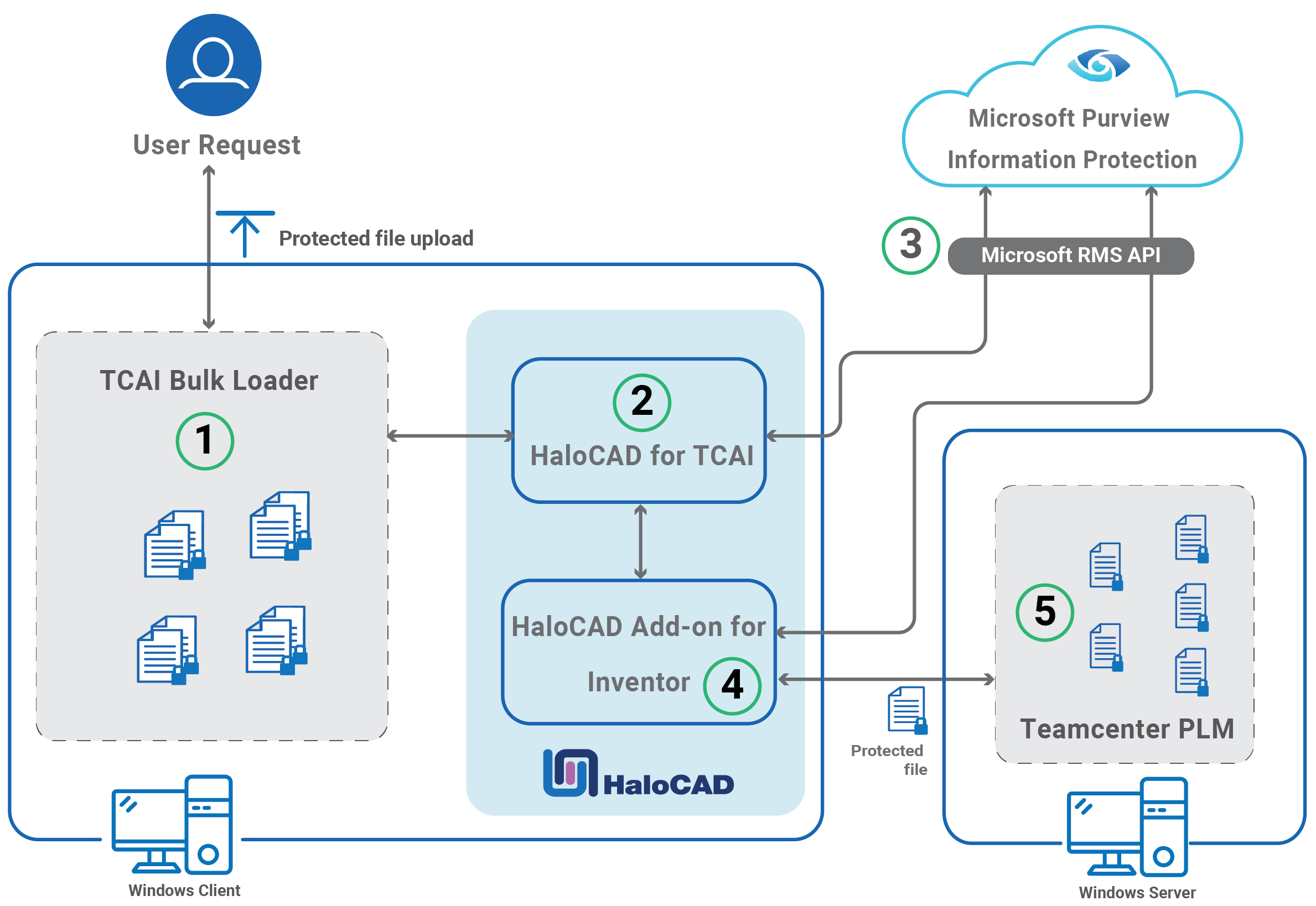
At a high level, HaloCAD workflow involves the following steps:
HaloCAD for TCAI
-
The TCAI Bulk Loader is launched, and a folder containing protected Autodesk Inventor files is selected.
-
HaloCAD for TCAI starts automatically.
-
The selected folder is scanned, and each file is read. If a protected file is detected, HaloCAD establishes a connection with Microsoft Purview Information Protection (MPIP) to read the labeled file. The labeled files are then decrypted automatically in the background.
-
During the process, the protected files are opened automatically in the Inventor application.
-
The protected files are checked into Teamcenter.
Log files and User Reset
-
After you log in to the HaloCAD session and complete authentication through the Microsoft Sign-In Assistant, you can access the following log files:
-
HaloCAD logs at
%AppData%\Roaming\Secude\HaloCAD\tcai\halocad.log -
MIP SDK logs at
%AppData%\Roaming\Secude\HaloCAD\tcai\mip\logs\mip_sdk.miplog
-
-
To clear cached credentials, select Show hidden icons on the taskbar, right-click the Secude icon, and then select User Reset.
Checking in Protected Files into Teamcenter
Prerequisites: Ensure that the following components are installed and configured:
-
TCAI Bulk Loader
-
HaloCAD Add-on for Inventor
-
HaloCAD for TCAI
Procedure: Check In Protected Files
-
Start the Bulk Loader
-
Double-click the TCAI Bulk Loader icon on the desktop.
-
Autodesk Inventor and the TCAI application start automatically.
-
Enter your credentials and click Login.
-
When the Bulk Loader starts, HaloCAD for TCAI loads and displays the message: “Protected files can be loaded.”
-
Click OK.
-
-
Select the Folder
-
In the Bulk Loader window, click the ellipsis (…) next to the folder field.
-
In the Browse for Folder dialog box, select the required folder that contains the protected Inventor files.
-
Click Find Inventor Files.
Note:
To read labeled files, HaloCAD for TCAI requires a connection to the Microsoft Entra ID tenant through the Microsoft Sign-In Assistant. When prompted, click OK and follow the on-screen instructions to complete authentication. The user credentials are cached. -
After successful authentication, the Bulk Loader scans the selected folder. Wait for the scanning process to complete.
-
When the scan is complete, the list of detected files is displayed.
-
Under Automatic Data, click Assign to All to apply the value to all files in the list automatically.
-
When prompted with the message “Automatic data will be assigned to all the unassigned elements in grid. Do you want to continue?”, click Yes.
-
-
Load Files into Teamcenter
-
Click Validate and then click Start Loading in the toolbar.
-
When prompted with the message: “To allow bulk loading, it is necessary to clear the cache folder. Do you want to continue?”, click Yes.
-
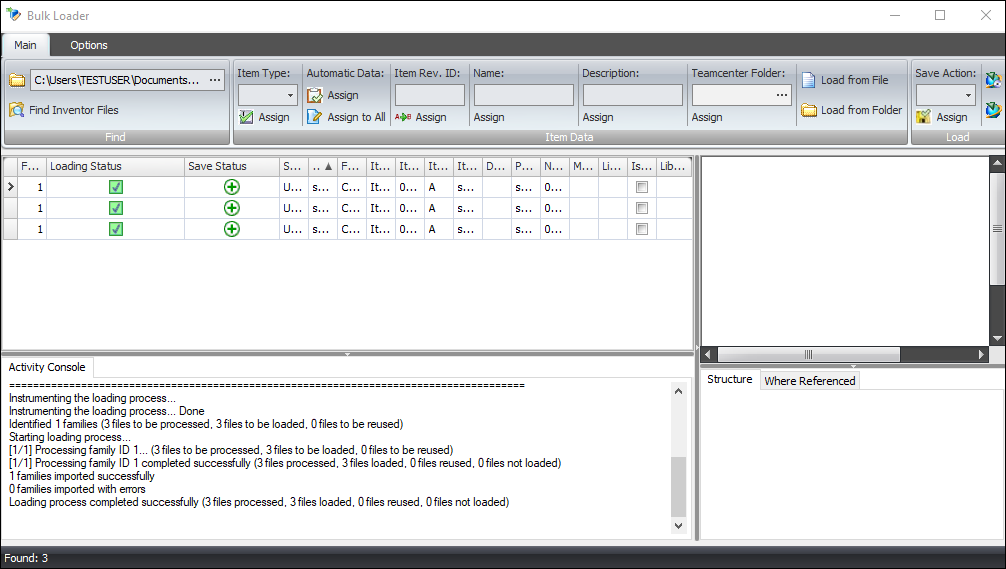
The loading process begins, and the list of files to be processed appears in the Inventor application window.
-
If auxiliary files (e.g., PDFs) are configured in Teamcenter, they are generated automatically.
Bulk Loader processing files
-
Results
-
In the Autodesk Inventor application, a message appears indicating successful completion: “Loading process completed successfully.” The message displays the following information:
-
Number of files processed
-
Files loaded
-
Files reused
-
Files not loaded
-
Click OK to close the message.
-
-
In the Bulk Loader window, the Loading Status of the files is displayed as success. The Activity Console displays the successful completion of the processed files.
-
In the Teamcenter console, the protected files appear as successfully checked in. The files remain protected because HaloCAD for PLM is not installed or configured.
Technical Support
Before contacting Technical Support, ensure that you have the following information available. Providing this information helps the support team investigate and resolve your issue more efficiently.
-
Full contact details
-
Product build version
-
Date, time, and description of the error (include screenshots, if possible)
-
Details of any third-party software used with the product
-
Any additional information required to reproduce the issue
Contact Technical Support
Secude provides technical support through email support@secude.com. When contacting Technical Support by email, include your company details, a detailed description of the issue, and the relevant log files (if available). A support representative will respond to your inquiry.
Additional Resources
Visit the Secude website https://secude.com to learn about upcoming events, press releases, and to download white papers.
Documentation Feedback
Secude values your feedback and continuously strives to improve product documentation. To provide feedback, send an email to: documentation@secude.com
Include the following details in your feedback:
-
Product name and version
-
Documentation topic
-
Description of the suggestion or error
The technical documentation team reviews all feedback and incorporates relevant updates in future documentation releases.
Appendix
This section provides supplemental information.
Third-Party Libraries
Third-party software/code is included or bundled with Secude's products according to its appropriate license. Secude conducts testing to make sure the third-party products are compatible with and perform as intended with Secude applications.
The third-party libraries and dependencies used by HaloCAD for TCAI are shown in the table below.
|
Library |
Version |
Source Code |
License Link |
|---|---|---|---|
|
Mhook |
2.5.1 |
||
|
Boost |
1.75.0 |
- |
- |
|
Protobuf Library |
3.15.6 |
https://github.com/protocolbuffers/protobuf/blob/master/LICENSE |
|
|
OpenSSL |
3.4.1 |
||
|
Rapidxml |
1.13 |
https://sourceforge.net/projects/rapidxml/files/latest/download |
|
|
tbb |
2021.6.0 |
https://github.com/dwaddington/tbb-2018/blob/tbb_2018/LICENSE |
|
|
MSAL |
4.72.1 |
https://github.com/AzureAD/microsoft-authentication-library-for-dotnet |
https://github.com/AzureAD/microsoft-authentication-library-for-dotnet/blob/master/LICENSE |
|
ConfuserEx |
1.0.0.0 |
||
|
WTL |
10.0.10320 |
||
|
MIP SDK |
1.18.103 |
https://learn.microsoft.com/en-us/information-protection/develop/version-release-history |
https://docs.microsoft.com/en-us/information-protection/develop/ |
Third-party libraries
Uninstalling the HaloCAD for TCAI
When you no longer use HaloCAD for TCAI, you may uninstall the application. Uninstalling removes all files and registry settings that were added to your computer during the initial installation.
Installer Version Requirement
When uninstalling the HaloCAD add-on, use the installer for the currently installed version, whether you run it by double-clicking the installer or from the command line. Using a different installer version may result in errors.
Method #1
-
Click Start menu > go to Control Panel > Programs > Programs and Features > Uninstall a Program > select HaloCAD for TCAI application from the list > right-click and select Uninstall option or double-click on the installer
HaloCAD_TCAI_Shield_Setup.exefile. -
Depending on your Windows security settings, you may get a security warning as "Do you want to allow the following program to make changes to this computer?". If you get this security warning, click the Yes button to confirm that you want to uninstall the add-on.
-
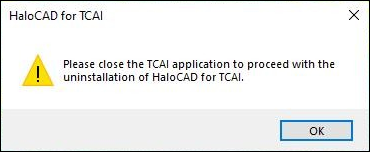
The HaloCAD installer first checks whether the TCAI application is running in the current user session. If detected, the installer displays a notification prompting you to close the application before continuing the uninstallation.
Uninstall Message #1
-
Click OK and close the TCAI application.
-
Redo step 1, and the following confirmation message appears.
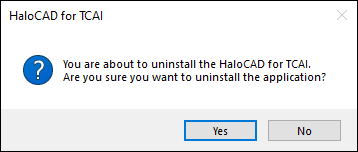
Uninstall Message #2
-
Click Yes to confirm the uninstallation of HaloCAD from your computer.
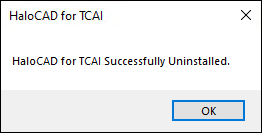
Uninstall Message #3
-
The HaloCAD component has been successfully uninstalled. Click OK to close the dialog box.
Method #2
The following example shows how to uninstall HaloCAD for TCAI from the command line.
-
Open a command prompt.
-
Navigate to the directory of the add-on installer.
Example:HaloCAD_TCAI_Shield_Setup.exe -uninstall -silent true -
The uninstalling process is complete.